
 Leaving the Costa del Sol, we began our journey inland and westward to discover the deeper history and culture of Andalusia, a region whose identity reaches far beyond its beaches and coastal towns. As we left the Mediterranean shoreline behind, the landscape opened into rolling hills, whitewashed villages, and fertile plains—an introduction to a territory shaped by centuries of cultural blending and artistic achievement.
Andalusia, stretching across southern Spain from the Mediterranean to the Atlantic, is a region defined by its long history of cultural exchange and maritime life. Its story reflects a succession of civilizations—Phoenicians, Romans, Visigoths, and, most profoundly, the Moors—each leaving a distinctive imprint on its architecture, language, music, and traditions.
For nearly eight centuries, much of Andalusia belonged to al-Andalus, the medieval Islamic kingdom that became one of the great intellectual and artistic centers of Europe. Advances in science, mathematics, philosophy, architecture, and agriculture flourished here, blending influences from North Africa, the Middle East, and the wider Mediterranean world.
The region’s major coastal cities—Málaga, Cádiz, Almería, and Huelva—served as vital maritime gateways connecting the Iberian Peninsula with ancient trade routes and later with the Atlantic voyages of exploration. Together, these influences forged a region rich in heritage, diversity, and cultural depth—a place where the past remains vividly alive in every plaza, hilltop fortress, and winding street.
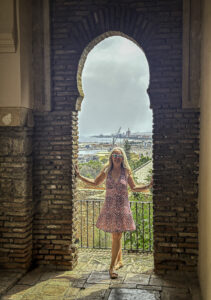
Málaga, set along the sunlit shores of Spain’s Costa del Sol, is one of Europe’s oldest coastal cities and a cultural crossroads of the Mediterranean. Founded by the Phoenicians nearly 3,000 years ago, the city later flourished under Roman, Moorish, and Christian rule—each era leaving landmarks that shape its modern character. 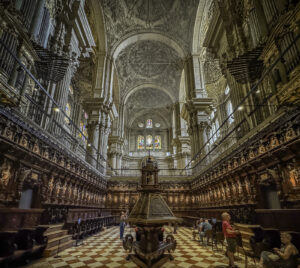 Overlooking the harbor, the Alcazaba, a Moorish fortress built in the 11th century, rises beneath the older Gibralfaro Castle, offering sweeping views of the coastline and cityscape.
The Málaga Cathedral, often called La Manquita—“the One-Armed Lady”—is one of Andalusia’s most distinctive Renaissance landmarks. Built between the 16th and 18th centuries on the site of a former mosque, the cathedral features a harmonious blend of Gothic, Renaissance, and Baroque elements. Its most striking feature is its unfinished south tower, which gives the building its affectionate nickname. Inside, soaring columns, richly carved choir stalls, and luminous chapels create a serene and elegant atmosphere. The cathedral’s rooftop terraces offer panoramic views over Málaga’s historic center, the harbor, and the surrounding hills, making it both an architectural gem and one of the city’s most memorable vantage points.
At street level, Málaga blends historic charm with contemporary energy. Its Roman amphitheater lies just steps from lively pedestrian boulevards, Renaissance churches, and the birthplace of Pablo Picasso, whose legacy is celebrated in the city’s acclaimed museums. The refurbished port area—Muelle Uno—adds a modern waterfront promenade lined with cafés, galleries, and sea views that connect the historic center to the Mediterranean.
Balancing ancient heritage, artistic vitality, and a relaxed seaside lifestyle, Málaga has evolved from a quiet port into one of Andalusia’s most vibrant cultural cities, making it a compelling gateway to the wider region. Click on thumbnail to view images


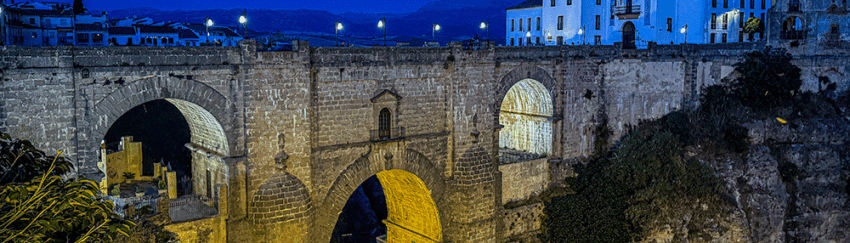
Our next stop was Ronda, one of Andalusia’s most dramatic and storied hill towns, sits perched atop a sheer limestone plateau dramatically split by the deep El Tajo gorge. This striking natural chasm divides the town into its old Moorish quarter and the later, more modern district, giving Ronda one of the most memorable settings in Spain. Founded by ancient Iberians and later developed by Romans and Moors, the town’s elevated position made it a natural stronghold throughout antiquity and the medieval era. The towering Puente Nuevo, completed in the 18th century, spans the gorge with breathtaking scale and engineering, offering sweeping views of the rolling countryside and rugged mountains beyond.
During our stay in Ronda, we were fortunate to stay at a charming Hemingway Hotel long associated with Ernest Hemingway, who spent considerable time in the city and immortalized it in several of his works. The hotel, with its traditional Andalusian architecture, wrought-iron balconies, and warm, rustic décor, captures the spirit of old Ronda. Overlooking narrow streets and dramatic vistas, it offered a perfect blend of comfort and atmosphere. Sitting in its cozy lounge—imagining Hemingway writing or gazing out over the gorge—added a romantic layer to our experience in this historic mountaintop town.
Ronda’s old quarter preserves the character of its Islamic past with narrow lanes, stone gates, and traditional whitewashed houses clustered within remnants of medieval walls. The town also holds one of Spain’s oldest and most historically significant bullrings, the Plaza de Toros, which played a key role in the evolution of modern bullfighting traditions. Across Ronda, visitors encounter Roman baths, Moorish palaces, and aristocratic mansions that reflect centuries of cultural blending.
Surrounded by the dramatic landscapes of the Serranía de Ronda, the town combines natural beauty with deep historical resonance. With its stunning vistas, layered heritage, and distinctive energy, Ronda remains one of Andalusia’s most atmospheric and unforgettable destinations. Click on thumbnail to view images


After saying goodbye to Ronda, one of our favorite stops in Andalusia, we began our journey back toward the coast. The drive carried us through beautiful Spanish countryside, with rolling hills, olive groves, and whitewashed villages scattered across the landscape—classic scenes of rural Andalusia that made the route as memorable as the destinations themselves. From there, we left Spain briefly for a short stay at the legendary Rock of Gibraltar.
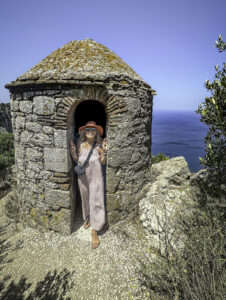 Gibraltar, a British territory at the southern tip of the Iberian Peninsula, has been a landmark of strategic importance for more than three thousand years. Dominated by the towering Rock of Gibraltar, the site has long been identified as one of the ancient Pillars of Hercules, marking the western gateway of the Mediterranean. Throughout history, the Phoenicians, Carthaginians, and Romans all recognized the rock’s formidable presence and valued it for its commanding views over the narrow strait that separates Europe and Africa.
During our visit, we took the tram to the top of the Rock, where the views were nothing short of spectacular—Spain stretching behind us, Africa visible across the water, and the Mediterranean opening wide to the east. From there, we walked the miles of trails that wind down toward the city, stopping to explore historic military installations that once defended this strategic outpost. Along the way, we encountered Gibraltar’s famous Barbary macaques, who seemed just as curious about us as we were about them. Their antics added a lively touch to our descent as we continued taking in the sweeping vistas that make Gibraltar such a remarkable and unforgettable place.
In 711 CE, Gibraltar became a key landing point for Muslim forces entering the peninsula, beginning centuries of Islamic rule that 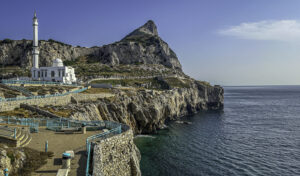 shaped much of southern Spain. In 1704, during the War of the Spanish Succession, an Anglo-Dutch fleet captured Gibraltar, and the territory was formally ceded to Britain by the Treaty of Utrecht in 1713. Its position at the mouth of the Mediterranean made it one of the most strategic military outposts in the world, especially during the Napoleonic Wars and World War II, when its tunnels and fortifications were expanded deep inside the rock.
Despite its military history, Gibraltar also reflects a remarkable blend of cultures—British, Spanish, Jewish, Genoese, Portuguese, and North African—visible in its languages, cuisine, and daily life. Today, Gibraltar is known for its dramatic cliffs, historic fortifications, lively port, and views across the strait toward Morocco. With its layered past and unique location, it remains one of Europe’s most distinctive cultural and geographic crossroads. Click on thumbnail to view images


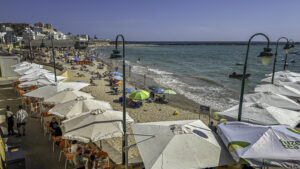 Spanish Crown. During the Age of Exploration, Cádiz became one of Spain’s most important gateways to the Americas, and in the early 19th century, it hosted the drafting of the


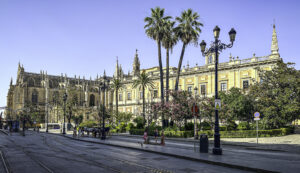 After the Christian reconquest in 1248, Seville rose to prominence as a key trading hub. Its greatest transformation came in the 16th century, when it became Spain’s primary gateway to the New World. Wealth from the Americas flowed through its river port, funding grand monuments such as the


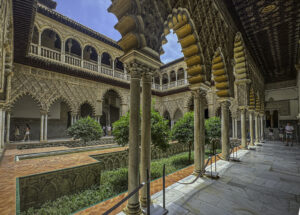 peaceful courtyards—such as the famous


