
 After leaving Andalusia the next phase of our journey took us to Southern Portugal, stretching from Faro in the Algarve to the coastal plains south of Lisbon. This region has been shaped by a succession of civilizations drawn to its mild climate, fertile land, and Atlantic coastline. The Algarve Region, centered on Faro, was first settled by Phoenician traders and later became an important Roman territory known for its ports, fisheries, and villa estates. After the fall of Rome, the area flourished under Moorish rule from the 8th to the 13th century, leaving a lasting influence on its architecture, agriculture, and place names. Faro, Silves, and Lagos were key urban centers during this period, known for their fortified walls, bustling markets, and sophisticated irrigation systems.
With the Christian Reconquest in the 12th and 13th centuries, southern Portugal was brought into the growing Portuguese kingdom. The region later played a vital role during the Age of Discovery, as the Algarve’s sailors, shipbuilders, and navigators helped launch Portugal’s maritime expansion. Ports such as Lagos became staging grounds for early Atlantic voyages, and the rugged coastline northward toward the Alentejo served as a testing ground for seamanship along challenging, wind-swept shores.
By the time the road approaches the southern outskirts of Lisbon, the journey reveals a region deeply marked by maritime heritage, ancient settlements, and a cultural blend that traces its roots to Phoenicians, Romans, Moors, and early Portuguese explorers. Southern Portugal’s coastline embodies both the historic heart of the Algarve and the timeless rural character of the Alentejo—two regions united by centuries of Atlantic tradition.
 Faro, the capital of Portugal’s Algarve region, has been an important coastal settlement for more than two millennia. Originally settled by the Phoenicians and later developed by the Romans as Ossonoba, it became a prosperous port known for its salt, fish, and agricultural trade. In the 8th century, Faro came under Moorish rule, a period that shaped much of its urban layout, defensive walls, and cultural identity. The city’s name itself derives from the Arabic Fahru.
After the Christian reconquest in the 13th century, Faro grew as a fortified town and later as a regional administrative center. Its Old Town (Cidade Velha), enclosed by medieval and Moorish-era walls, still preserves cobbled streets, whitewashed buildings, and the 13th-century Sé Cathedral, built atop the foundations of a former mosque. Despite damage from pirate attacks and earthquakes, Faro remained a resilient coastal hub.
Today, Faro blends its long maritime history with a calm, authentic atmosphere. Its harbor, historic center, and proximity to the protected Ria Formosa lagoon make it both a cultural gateway to the Algarve and a reminder of the region’s deep ties to the sea. Click on thumbnail to view images


Our next stop was Lagos, on Portugal’s western Algarve coast, an historic maritime town shaped by centuries of exploration, trade, and seafaring tradition. Originally settled by Carthaginians and Romans, the town rose in importance under Moorish rule, when its harbor became a vital link in regional commerce. After the Christian  reconquest in the 13th century, Lagos became one of the principal staging grounds for Portugal’s Age of Discovery. In the 15th century, Prince Henry the Navigator used the region as a base for voyages down the coast of Africa, making Lagos a center of early navigation, shipbuilding, and chartmaking.
The Old Town, enclosed by medieval walls, preserves this layered heritage with cobblestone streets, baroque churches, and remnants of early fortifications. It is a wonderful place to stroll through winding lanes, explore the numerous small shops, and enjoy excellent local food in cozy cafés and traditional restaurants. Its waterfront—lined with fishing boats, promenades, and historic warehouses—reflects a long-standing connection to the sea.
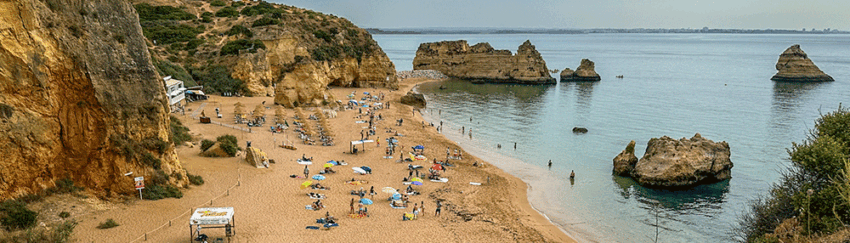
On another day we explored the stunning rock formations of Ponta da Piedade, one of the Algarve’s most iconic natural wonders. Carved over millions of years by wind, waves, and shifting tides, these golden limestone cliffs rise dramatically above the turquoise water, forming a labyrinth of arches, sea stacks, grottoes, and hidden coves. The name “Piedade,” meaning “piety,” reflects the awe these formations have inspired for centuries, and sailors once used the cliffs as natural markers along the rugged coastline. Whether viewed  from clifftop trails or from a small boat navigating the narrow passages below, the scenery is unforgettable—shimmering light on the water, sculpted stone glowing in warm hues, and the Atlantic stretching endlessly beyond.
After our morning of exploration, we spent the afternoon relaxing at the beautiful Praia Dona Ana, a sheltered beach framed by more limestone formations and celebrated for its calm waters and striking natural backdrop. It was the perfect place to unwind and soak up the Algarve sun.
Next we took a short drive west leading to Ponta de Sagres, a windswept headland long linked to the early days of Portuguese exploration. Here, the Sagres Fortress stands on a cliff above the Atlantic, marking a place where mariners trained, observed the sea, and set out on pioneering voyages. The dramatic meeting of cliffs, ocean, and open horizons earned Sagres a legendary reputation as “the end of the world” in medieval Europe.
Together, Lagos and Ponta de Sagres blend deep maritime history with striking natural landscapes, capturing the spirit and legacy of Portugal’s Atlantic frontier. Click on thumbnail to view images


From Lagos we continued our drive up the west coast passing through the protected landscapes of the Costa Vicentina, a region known for its rugged cliffs, sweeping  beaches, and rural charm. We stopped in Aljezur, founded in the 10th century during Moorish rule, is a quiet whitewashed town divided by a river and crowned by the ruins of a hilltop Moorish castle. Its narrow lanes, traditional houses, and nearby surf beaches—such as Arrifana and Amoreira—reflect a blend of history and natural beauty that defines the western Algarve.
Traveling north along the dramatic coastline leads to Vila Nova de Milfontes, a picturesque seaside town situated at the mouth of the Mira River. Founded in the early 16th century as a defensive outpost, it retains a relaxed maritime character with its small fort, sandy riverfront, and gently winding streets overlooking the Atlantic. The surrounding coastline, marked by dunes, rocky headlands, and quiet beaches, is among the most pristine in Portugal.
Together, Aljezur and Vila Nova de Milfontes capture the essence of Portugal’s southwestern coast—historic villages, striking ocean landscapes, and a peaceful rhythm shaped by centuries of rural life and the power of the Atlantic. Click on thumbnail to view images


