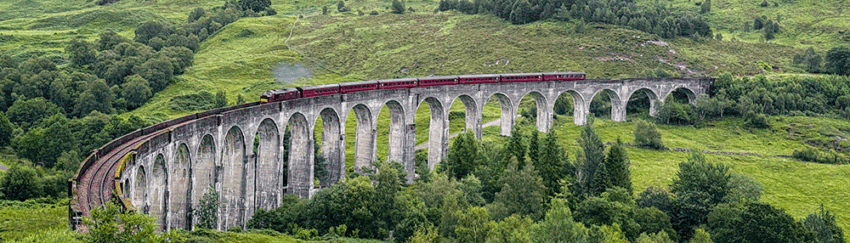
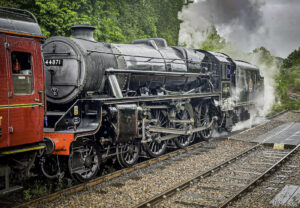
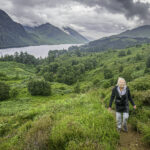
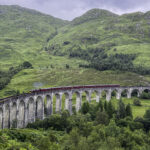
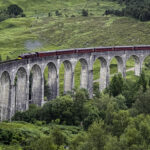
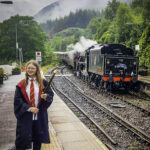
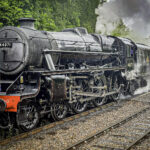
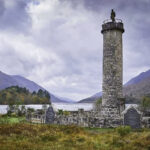
 Britain’s highest mountain. Long known as a hub for climbers, hikers, and outdoor adventurers, Fort William serves as a natural gateway to the rugged landscapes of the Highlands, where lochs, glens, and peaks stretch in every direction. From there, we continued north and west through increasingly remote terrain toward one of Scotland’s most beloved and recognizable landmarks—the
  to witness the iconic scene firsthand.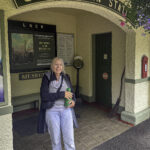


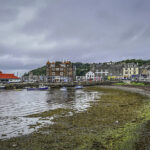
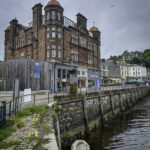
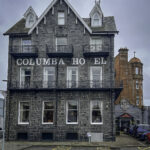
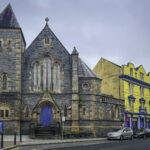
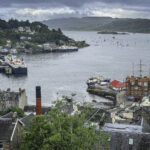
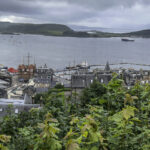
From Glenfinnan, we continued south to the coastal town of Oban, often called the Gateway to the Isles. Nestled around a sheltered bay on Scotland’s western shore, Oban grew from a small fishing village into an important port and ferry hub during the 19th century, especially after the arrival of the railway in 1880. Its natural harbor, protected by the island of Kerrera, made it an ideal launching point for travel throughout the Hebrides.
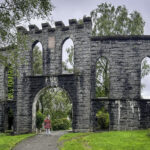
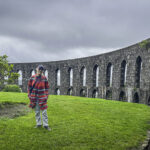
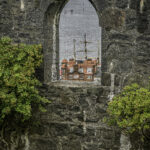
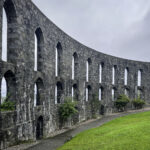
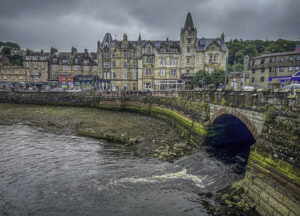 Oban is crowned by the distinctive McCaig’s Tower, a 19th-century granite structure modeled loosely after the Roman Colosseum. Built by a local philanthropist to provide winter employment, it overlooks the town and offers sweeping views of the bay and surrounding islands. Along the waterfront, Victorian buildings, seafood restaurants, and working fishing boats reflect the town’s maritime heritage.
The town also played a significant role during World War II as a base for both the Royal Navy and flying boat operations, adding another layer to its rich history.
Today, Oban is known for its lively harbor, excellent whisky from the Oban Distillery, and access to some of Scotland’s most scenic island landscapes. Click on thumbnail to view images
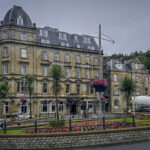
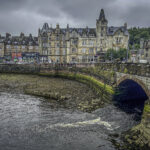
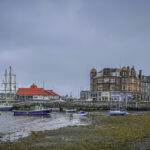
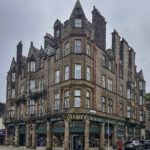
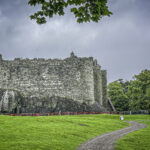
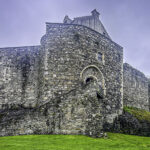
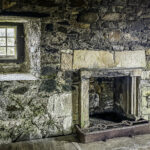
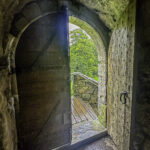
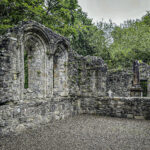
After leaving Oban, we began our journey toward Stirling, stopping first at Dunstaffnage Castle, one of Scotland’s oldest stone fortresses. Built around the early 13th century by the powerful MacDougall clan, the castle occupies a dramatic position on a rocky promontory guarding the entrance to Loch Etive. Over the centuries, it passed into the hands of the Campbell family and played a notable role in the Wars of Scottish Independence. Its thick stone walls, rounded towers, and commanding views reflect its long history as a strategic coastal stronghold.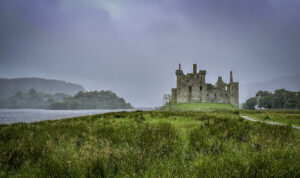 Just outside the curtain wall stands Dunstaffnage Chapel, a 13th-century ruin with elegant Gothic arches. Though roofless today, the chapel remains a peaceful and atmospheric reminder of the spiritual life that once centered around the castle.
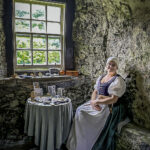
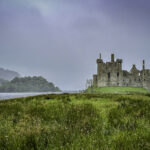
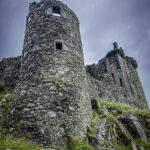
Continuing east, we stopped at the hauntingly beautiful Kilchurn Castle, one of Scotland’s most photographed ruins. Built in the mid-1400s by Sir Colin Campbell, the first Lord of Glenorchy, Kilchurn became the ancestral seat of the Campbells of Breadalbane. Set on a small peninsula at the northeastern end of Loch Awe—often surrounded by water in winter—it offers a postcard-perfect silhouette against the surrounding mountains. Through the 17th century, the castle served both as a residence and a military barracks before being abandoned after lightning damage in 1760. Click on thumbnail to view images
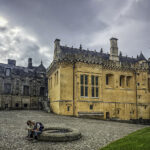
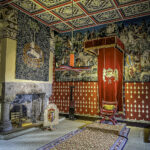
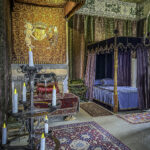
Our day ended inland at Stirling, often described as the “Gateway to the Highlands,” is one of Scotland’s most historically important cities. Its strategic location—where the Lowlands meet the Highlands—made it a focal point for trade, power, and conflict for centuries. At its heart stands the magnificent Stirling Castle, perched high on a volcanic crag and long considered one of Scotland’s grandest royal residences. It was here that the Stewart monarchs held court, where Mary, Queen of Scots, was crowned, and where Scottish royalty oversaw a flourishing of Renaissance art and architecture.
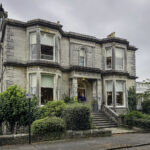
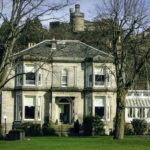
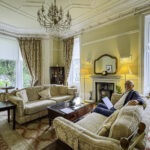
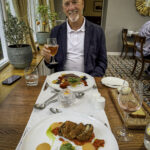
During our stay, we were welcomed by the elegant Victoria Square Guesthouse, a beautifully restored Victorian townhouse located in one of Stirling’s quiet, tree-lined neighborhoods. Its warm hospitality, refined décor, and peaceful setting made it an ideal base for exploring the city’s rich history. With its blend of comfort and character, the guesthouse provided a restful retreat after days spent discovering the landmarks and stories that define Stirling. Click on thumbnail to view images

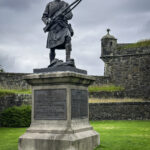
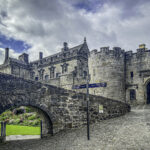
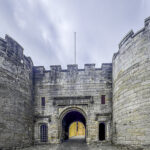
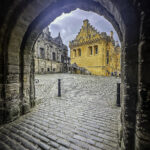
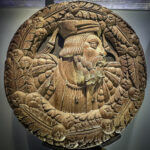
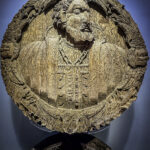
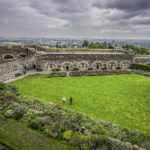
Stirling Castle, commanding a dramatic volcanic crag high above the River Forth, is one of Scotland’s most important and visually striking fortresses. Its elevated position, with sheer cliffs on three sides, made it a naturally defensible stronghold and a powerful symbol of royal authority. Strategically located at the narrowest crossing 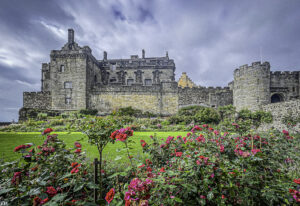 point of the Forth, the castle guarded the vital crossroads between the Highlands and the Lowlands, controlling the main routes linking northern and southern Scotland. For centuries, whoever held Stirling Castle effectively controlled the gateway to the kingdom.
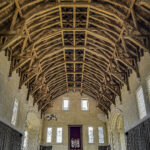
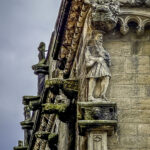
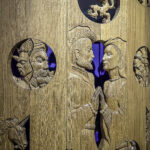
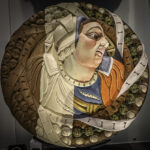
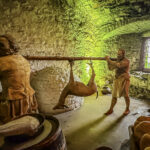
The castle’s origins date back to at least the 12th century, though much of what visitors see today reflects the Renaissance splendor of the 15th and 16th centuries. During this golden era, Stirling became a favored royal residence of the Stewart monarchs, who sought to display their power and sophistication through architecture and art. The magnificent Great Hall, with its towering hammerbeam roof, was the largest secular building in Scotland at the time and served as a setting for 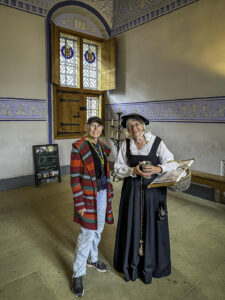 banquets, ceremonies, and royal gatherings. Nearby, the richly decorated Royal Palace stands as one of the finest Renaissance buildings in Britain, while the Chapel Royal reflects both religious devotion and royal prestige. Kings such as James IV and James V transformed the castle into a vibrant center of court life, entertainment, and political influence.
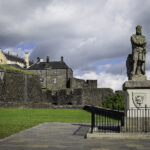
Stirling Castle is also inseparable from the story of Scottish independence. It stood at the heart of key military struggles, including the Battle of Stirling Bridge (1297), where William Wallace and Andrew de Moray achieved a stunning victory against English forces, and the Battle of Bannockburn (1314), where Robert the Bruce secured Scotland’s most celebrated triumph. Throughout the Wars of Independence, the castle changed hands multiple times, enduring sieges, bombardments, and repeated assaults that tested the strength of its defenses and the resolve of those who held it.
Beyond warfare, Stirling Castle played a central role in royal ceremony and daily life. Mary, Queen of Scots, was crowned here in 1543 as an infant, and the castle later served as a residence and training ground for young royalty. As a place where power was asserted, alliances forged, and national identity shaped, Stirling Castle remains one of Scotland’s most compelling symbols of history, resilience, and sovereignty. Click on thumbnail to view images
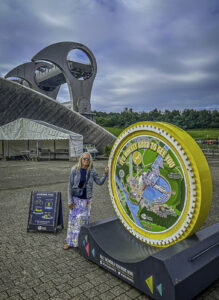 Fro Sterling we took a side trip to see the amazing Falkirk Wheel in action. Located between Edinburgh and Glasgow, it is one of Scotland’s most striking examples of modern engineering blended with artistic design. Opened in 2002 as part of the Millennium Link project, the wheel was created to restore a navigable connection between the Forth & Clyde Canal and the Union Canal—two major waterways originally completed in the early 1800s to link Scotland’s east and west coasts. These canals were once vital arteries for trade and industry, but by the mid-20th century, declining use and the removal of the original 11-lock staircase had severed the link between them for more than 70 years.
Rather than reconstruct the traditional locks, planners sought a bold and imaginative solution. The result was the Falkirk Wheel, the world’s first and only rotating boat lift. Rising 35 meters above the surrounding landscape, the wheel functions with extraordinary precision: two gondolas, or caissons, remain perfectly balanced regardless of load, allowing the entire mechanism to rotate using minimal power—roughly the equivalent of boiling a single household kettle. This efficiency is made possible by Archimedes’ principle, which ensures that each caisson always contains the same total weight of water and vessels.
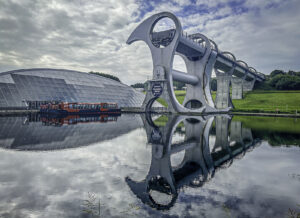 The design of the wheel is as remarkable as its engineering. Inspired by Celtic patterns, modern propeller blades, and the sweep of traditional boat-building forms, it stands as both a functional machine and a sculptural landmark. Its smooth rotation lifts boats from the lower canal basin to the upper aqueduct in just a few minutes, offering passengers a unique and almost otherworldly experience.
The Falkirk Wheel has since become a celebrated symbol of Scotland’s ability to honor its industrial heritage while embracing innovation and creativity. Today, visitors can watch boats quietly rise into the air, enjoy the surrounding parkland, and appreciate one of the most imaginative engineering projects of the modern era—an elegant solution that reconnects waterways, communities, and history.
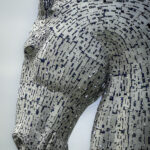
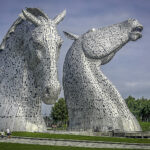
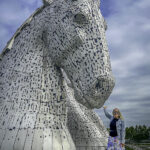
Often referred to informally as the Stirling Horses, the towering sculptures known as The Kelpies rise dramatically from the landscape near Falkirk, not far from Stirling. Completed in 2013, these 30-meter-tall steel horse heads are the largest equine sculptures in the world and have become one of Scotland’s most recognizable modern landmarks.
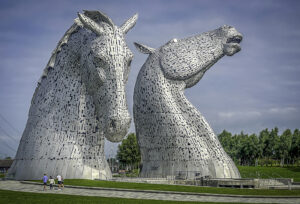 Created by sculptor Andy Scott, The Kelpies were designed as a powerful tribute to Scotland’s working heritage. For centuries, heavy horses—Clydesdales, Shires, and other draft breeds—were the backbone of industry across the region. They hauled canal barges, plowed fields, and powered the early industrial economy. The sculptures celebrate the strength, endurance, and quiet dignity of these animals that shaped daily life long before mechanization.
Their name comes from kelpies, mythical shape-shifting water spirits said to inhabit Scotland’s rivers and lochs. By blending industrial history with ancient folklore, the sculptures bridge Scotland’s past and present. Sitting alongside the Forth & Clyde Canal, the Kelpies mark the eastern gateway to The Helix, a major land-renewal project designed to reconnect communities and revitalize public spaces.
Made from hundreds of stainless-steel plates, the sculptures shimmer in daylight and glow at night, creating an ever-changing presence. Visitors can even walk inside one of the structures, where the design’s intricate engineering becomes visible from within. Click on thumbnail to view images
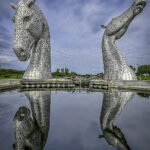
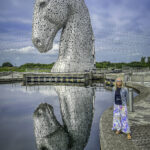
After a wonderful day visiting the Falkirk Wheel and the Kelpies, we returned to Stirling for the night, savoring the last moments of our time in central Scotland. Tomorrow we will drive south to Girvan, where we’ll return our rental car before continuing by train the following morning to Stranraer for our final night in Scotland. The next day, we head to nearby Cairnryan to meet our ferry to Belfast and begin the next chapter of our journey.
What an amazing time we have had exploring Scotland—its landscapes, its history, and its warm hospitality—and especially the days spent with our dear Scottish friends, Maggie and Gordon White, whose generosity and companionship made this part of our adventure truly unforgettable.